
Anticipated release: Q3 of 2016
In early 2015, back when Windows Server 2016 was still known only by its codename of "vNext," Microsoft said that the server OS's architecture would be "deeply refactored" to support cloud scenarios, which certainly sounds like a major development albeit in an abstract sort of way. However, subsequent dispatches from Microsoft have been more explicit about the changes coming to Windows Server 2016 -- and they're big changes.
First, Windows Server 2016, which Microsoft is expected to release in Q3 of this year, will feature Windows Server Containers and Hyper-V Containers. The former debuted in the third Windows Server 2016 technical preview that was released in August, and the latter in the fourth technical preview released in November.
Second, Windows Server 2016 will include a "Nano Server" component, which Microsoft Distinguished Engineer Jeffrey Snover described as "the most important, most significant change that we've made since Windows NT." As Microsoft explains it, "Nano Server is a deeply refactored version of Windows Server with a small footprint and remotely managed installation, optimized for the cloud and a DevOps workflow. It is designed for fewer patch and update events, faster restarts, better resource utilization and tighter security." According to Microsoft, Nano Server is 20 times smaller than Server Core and, compared to Windows Server, has a virtual hard disk size that's 93 percent smaller, is affected by 92 percent fewer critical bulletins, and requires 80 percent fewer system reboots.
Nano Server saw daylight in May 2015 as part of the second technical preview of Windows Server 2016. At that time, Microsoft said Nano Server was designed for three roles: as the host OS for cloud computing scenarios using Hyper-V, as a platform for deploying cloud-native apps, and as a host for scale-out file server operations. In November, Microsoft expanded those server roles to also include DNS Server and Web Server (IIS) roles. Nano Server doesn't replace Server Core, however; Windows Server 2016 will allow for both options. Organizations can also decide to do a full server installation. "Applications and services will need to be evaluated on a case by case basis to determine the best operating system footprint," Microsoft said.
Third, Microsoft has decided to switch to a per-core licensing approach with Windows Server 2016, a departure from its previous per-processor approach. The repercussions of that change were outlined in a detailed FAQ from Microsoft, which said that the switch aims to "evolve our server licensing to support hybrid cloud." Windows Server 2016 will be licensed in two flavors: Standard Edition (for "low to no virtualization scenarios") and Datacenter Edition (for "unlimited virtualization").
Microsoft describes the license packages this way: "Core licenses will be sold in packs of two licenses. Each processor will need to be licensed with minimum of 8 cores which is 4 two-core packs. Each physical server, including 1 processor servers, will need to be licensed with minimum of 16 cores which is 8 two-core packs. Additional cores can then be licensed in increments of two cores (one two core pack) for gradual increases in core density growth." [BACK TO TOP | BACK TO PRODUCT LIST]
System Center 2016
Anticipated release: Q3 of 2016
Like the upcoming Windows Server 2016, the next-generation version of Microsoft's datacenter management suite is expected to arrive in Q3 with a new core-based licensing model. According to a Microsoft licensing datasheet, the decision to mimic Windows Server 2016's core-based model is an effort to "provide a consistent licensing metric for managed VMs." For System Center 2016, the licensing will work this way:
The System Center 2016 licensing model for Standard and Datacenter will be the same as 2012 R2 with server and client management licenses. As with System Center 2012 R2, the 2016 editions will be differentiated by virtualization rights only. Licenses are required only for the endpoints being managed. No additional licenses are needed for the management server or SQL Server runtime.Besides the licensing change, Microsoft has also decided to go ahead and release the System Center Configuration Manager (SCCM) component in December 2015, ahead of the larger System Center 2016 suite, to address the needs of organizations managing Windows 10 clients. Brad Anderson, corporate vice president of Enterprise Client and Mobility at Microsoft, called that release of SCCM "the most significant and important release of ConfigMgr ever," and pointed to the fact that this Windows 10-optimized version of SCCM is also SaaS-enabled, meaning that organizations will receive regular monthly updates to the product.
The rest of the System Center 2016 suite, which is currently on its fourth technical preview, will arrive later this year. Microsoft is touting System Center 2016's integration with Microsoft Operations Management Suite (OMS) as a key improvement. "Through the integration with OMS, your System Center investments can manage traditional infrastructure, workloads, and modern applications with ease -- regardless of whether you're working with Azure or AWS, or running Windows Server, Linux, VMWare, or OpenStack," according to Microsoft. [BACK TO TOP | BACK TO PRODUCT LIST]
SQL Server 2016
Anticipated release: First half of 2016
So far, Microsoft hasn't given any hints about when it will release its next-generation relational database management solution, which is currently in its third community technology preview (CTP). However, it's a fair bet that the final version of SQL Server 2016 could appear before the end of summer, given that the last three major SQL Server versions -- SQL Server 2008 R2, SQL Server 2012 and SQL Server 2014 -- have all followed the pattern of being released to manufacturing (RTM) in March or April and becoming generally available a month or so later.
Changes and improvements coming in SQL Server 2016 include:
- A new feature called Always Encrypted, which protects both at-rest
and in-motion data by keeping the encryption keys within the
application.
- Integration with the R programming language via the new SQL Server R Services, improving analytics capabilities.
- The new Stretch Database feature, which lets users access more
historical data by enabling operational tables to extend between
on-premises and the Azure cloud.
- Native support for the JSON language.
- Built-in PolyBase, letting users query relational and non-relational data with T-SQL.
BizTalk Server 2016
Anticipated release: Q4 of 2016
Microsoft expects to roll out the tenth and newest version of its BizTalk integration platform in Q4, after the general availability of SQL Server 2016 and Windows Server 2016, according to a whitepaper the company released in late 2015. BizTalk Server 2016 will be closely tied to the development of Microsoft's other integration products, namely Host Integration Server and Logic Apps on Azure Stack, which are both in varying stages of development. Given these dependencies, there are several dates and moving parts to track when it comes to BizTalk Server 2016:
- Before its Q4 general availability, BizTalk Server 2016 will be released as a CTP in Q2 and as a beta preview in Q3.
- Host Integration Server's release milestones will follow the same ones as BizTalk Server.
- BizTalk Server also has an iPaaS (Microsoft's acronym for
integration Platform as a Service) counterpart called Azure BizTalk
Services that will become available in April.
- Logic Apps on Azure Stack will be released as a preview in Q3, with RTM expected in Q4.
- Alignment with the latest releases of SQL Server, Windows Server, Office and Visual Studio.
- Support for SQL Server 2016's AlwaysOn feature.
- Better integration with API connectors.
- Support for high-availability workloads in Azure IaaS.
Dynamics GP and Dynamics NAV
Anticipated release: Dynamics GP, first half of 2016
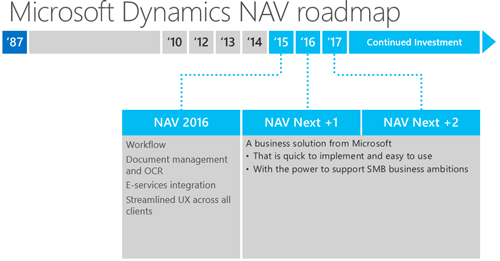
Dynamics NAV, to be announced Besides the aforementioned Dynamics AX, two more products in Microsoft's ERP lineup are expected to see daylight in 2016.
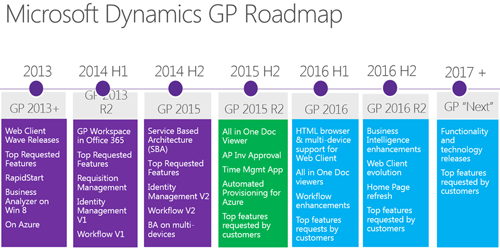
Dynamics GP 2016 will debut in the first half of the year, with an "R2" version rolling out in the second half. That's according to a Microsoft slide posted by Microsoft developer Tim Wappat in a September 2015 blog post (see below).


0 komentar:
Posting Komentar